Why fashion is in crisis and where recovery can begin

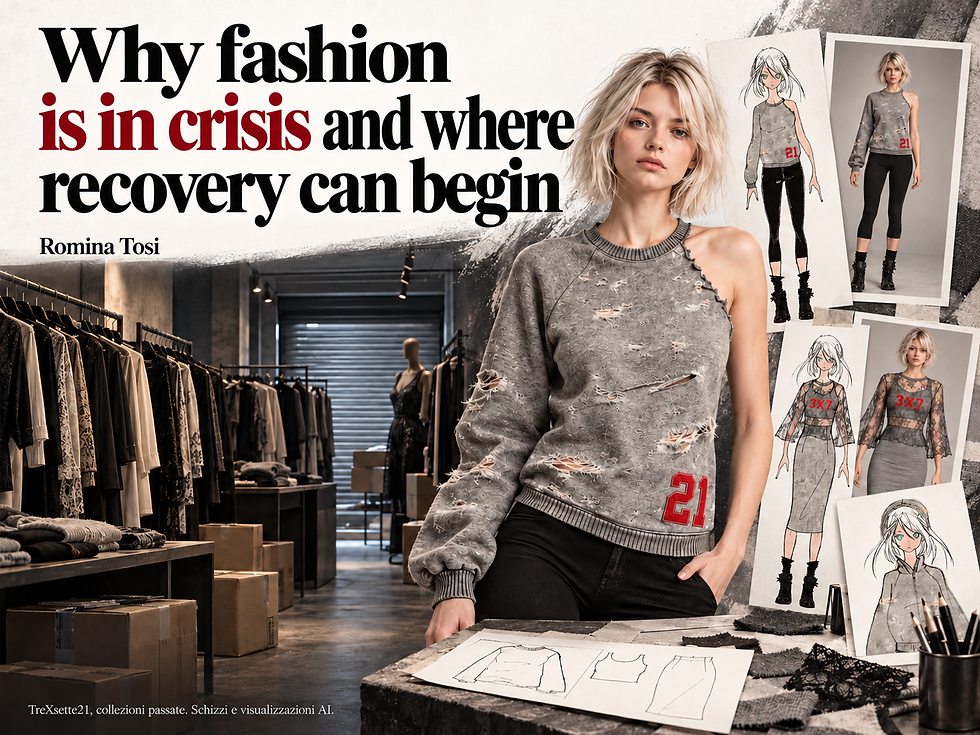
70% of consumers surveyed by BCG and Altagamma decided against a luxury purchase because they felt the price was unjustified. The finding comes from the 2026 True-Luxury Global Consumer Insights study, conducted among more than 10,000 consumers in 11 markets.
This is a judgement on price from luxury consumers, not a measure of product quality. Treating it only as an issue of affordability obscures where action is needed.
The fashion crisis has real economic causes, from weak consumer spending to geopolitical uncertainty. To understand why a company is losing competitiveness, its own decisions also need scrutiny: prices, the distinctiveness of its collections, quantities and distribution in relation to demand. Recovery requires work on the decisions that turn an idea into a product, then an assortment and finally a purchase.
There is no single balance sheet for fashion
A luxury house, a mid-market company and a workshop that supplies both can face very different problems in the same economic climate.
In the first nine months of 2026, LVMH’s Fashion & Leather Goods division recorded a 2% drop in revenue on an organic basis, meaning at constant exchange rates and scope of consolidation. Over the same period, Hermès grew by 5.5% at constant exchange rates. The businesses covered differ; these results alone do not explain the causes.
The base-case forecast in the 25 June 2026 Altagamma-Bain update pointed to annual growth of between 2% and 4% for personal luxury goods. A market forecast does not guarantee recovery for every business.
Premium brands may struggle to distinguish themselves from more affordable alternatives. A supplier can have excellent expertise and too few orders. Attributing everything to a loss of desire would be unfair, and not particularly useful.
The price has to hold up in person
Luxury carries symbolic and cultural value that no calculation of manufacturing costs can fully capture. The price also pays for research, identity, service and the pleasure of owning a particular object. Reducing it to the cost of materials would be a mistake.
But a product still faces a very simple test: someone touches it and tries it on. The feel of a fabric, the way a jacket hangs, a lining that moves with the body are all part of the design. A photograph captures only some of this.

In the lace top, transparency and the relationship with the layer beneath matter; in the sweatshirt, it is the distressed finish and the patch. The visualisation shows these design choices. Fabric feel, the durability of the details and comfort need to be checked on the sample: an image alone cannot establish whether the product justifies its price.
TreXsette21, past collections. Details from AI-generated photorealistic visualisations based on the original sketches.
In the same BCG-Altagamma study, design and aesthetics, craftsmanship and quality of execution, and lasting appeal are the leading stated reasons for buying. Logo visibility is the least important of the factors examined.
Communication gives a product context, builds a world around it and can make us want something we were not previously looking for. Expecting it to make up for neglected fit or an indistinct offer gives it a rather expensive extra job.
Making a price more credible calls for different choices depending on the problem. It may mean improving construction, reviewing a category, reducing overlaps or adjusting the price itself. A more substantial product does not necessarily create desire on its own.
There is also a comparison that happens outside the store. Altagamma-Bain reports that around half of personal luxury goods customers look at second-hand options before buying something new. Vintage therefore becomes one of the alternatives: it may offer a technique, a design or an era that the customer prefers to the current collection. New pieces also have to justify being chosen over what the brand has already produced.
The cost of a collection without a clear hierarchy
Every style adds development work. Colours, materials and sizes can multiply the combinations that have to be managed. Some of that variety serves a purpose; the part that repeats the same function absorbs sampling time and can fragment orders without creating new reasons to buy.
Collection architecture is about deciding what each product is there to do. A carryover style provides a recognisable base that can be reordered; a seasonal piece introduces something new; a piece created to express the brand’s image makes the design research visible. These functions can coexist within the same style. The “image” label should not, however, become a free pass to ignore costs or how the garment will be used.

The zip hoodie, asymmetric sweatshirt and lace outfit share a grey palette, but differ in silhouette and construction. Placing them side by side helps assess what each adds to the assortment. Their commercial roles also need to be considered in relation to intended use, price and sales feedback.
TreXsette21, past collections. Original design sketches.
Reducing the number of styles makes sense after this assessment. A blanket cut risks removing the products that make the brand recognisable, leaving a smaller collection that is still generic.
What counts as a sale also needs to be clear. Sell-in measures what the brand sells to retailers; sell-out measures what reaches the end customer. A strong opening order is not enough to establish whether customers bought the product, whether it stayed in stock or whether it needed a discount. That information needs to feed into the following season’s work.
Who decides before the collection is sampled
A collection can lose coherence through decisions that are reasonable in isolation. Replacing a material to contain cost can change its drape and require a new fitting. If the schedule does not allow it, the saving has to be weighed against the risk to the result. Someone needs to understand the project well enough to decide on that trade-off.
Product development needs to be able to discuss feasibility while the design can still be changed. Merchandising, which builds the assortment around customers and financial targets, must contribute before the final selection. Sales teams need to provide usable information: which styles are being reordered, where price meets resistance, which sizes are missing and why a garment comes back.

The close-up comparison makes the central zip, sleeve volume and ribbed hem clear. If a material is changed to contain cost, sleeve volume and the tension in the cuffs and hem need to be checked again on the prototype. The visualisation makes it easier to discuss these choices before the sample is made.
TreXsette21, past collections. Original design sketch and AI-generated photorealistic visualisation.
Creative direction must be able to interpret this information, while keeping room for ideas that past results cannot suggest. Basing every decision on previous sales would make it difficult to introduce anything new.
Management is also responsible for establishing who approves a change and what it means for quality, cost and the schedule. If that responsibility remains vague, the discussion can continue until the supplier has to start production.
AI can help analyse stock and demand. But before trusting it with a forecast, you need to know what the data contains: historical data full of promotions also reflects the company’s promotional decisions. It does not automatically show what customers would want to buy at full price.
The supply chain cannot restart on command
In the second quarter of 2026, EU clothing production fell by 6.2% compared with the same period a year earlier, according to EURATEX’s Economic Update.
For companies in the supply chain, irregular orders are a problem that a good marketing campaign by the client cannot immediately solve. Specialist production requires trained people, equipment and time. Once production capacity has been lost, it may be difficult to rebuild when demand returns.
Protecting it requires verifiable commitments: forecasts shared early, selective sampling, payment on time and limits on late changes. Training also needs a place in the schedule, with someone who can teach the craft on the job.
A brand that bases part of its price on craft expertise has an interest in understanding the conditions that allow its supplier to maintain that expertise. Pressure on cost needs to be weighed against what may be lost in quality, reliability and the scope to experiment.
Read the signals before changing everything
“The product isn’t working” is too broad a diagnosis. The table suggests some checks to narrow down the problem; the relationships shown are hypotheses to test against company data.

Full-price sell-through can help with this assessment. Here, we define it as the percentage of units sold at full price, net of returns, out of all units available during the period: opening stock plus replenishments received. Comparisons require the same category and channel, comparable time windows and consistent treatment of returns.
A high percentage can also reflect stock levels that were too low. It therefore needs to be read alongside size availability and the actual gross margin: what remains of revenue after discounts and returns, once the cost of goods sold has been deducted. Lost sales due to unavailable stock also need to be considered. They are difficult to measure, but far from irrelevant.
The next collection as a test
To start, a company can choose one specific category and retrace its decisions: products developed, products dropped, costs incurred, orders, deliveries, sales to end customers and returns. This work helps identify which corrections to test without changing the entire offer at once.
Results need to be assessed on the product’s real timetable. Revising an assortment does not generate revenue on the day it is approved. Where cash or orders are lacking, financial and operational action may be needed that creative direction alone cannot replace.
These findings should also be brought to the meeting about the next collection, alongside the sketches. With enough time to change a decision before it becomes a production order.
Romina Tosi
Disclaimer
The views expressed in this article reflect my personal analysis of the information available at the time of publication. The sources consulted are publicly available and may include official documents, trade union communications, press reports and other materials accessible to the public. Artificial intelligence tools were used to support the identification, consultation and preliminary verification of sources, as well as to locate and check the links included in the article. Before publication, I reviewed the relevant sources and verified that the links corresponded to the materials cited. AI assistance does not replace my editorial judgment or my responsibility for the final text. Links were checked at the time of publication and may subsequently be changed, moved or removed by their respective publishers. I do not disclose confidential information or information obtained through privileged professional access. Facts, statements, allegations and opinions are presented according to their nature. References to individuals, companies or specific cases are included to examine matters of broader relevance to the industry. They are not intended to attribute unlawful conduct beyond what is expressly documented in the cited sources. Assessments concerning industrial strategies, financial decisions and production models represent personal opinions, not findings of fact or definitive judgments.
If you identify an error or inaccuracy, please let me know. I will verify the information and correct it where necessary.
The purpose of this article is to contribute to informed discussion, not to harm any individual, company or organisation.


Comments