Approving a licensed garment requires shared criteria


A cover-worthy coat still needs to be cleaned. For the Lipeck K220-508 from Ki6? Who are you, Autumn Winter 2021, that meant being able to detach the large black Mongolian fur cuffs. The detail that gave the garment so much presence brought a very practical requirement with it, one that had to be resolved within the design.
The coat was intended for the upper-mid market. It had to be playful, the collection’s cover piece, with a comfortable, contemporary fit. There was the spotted wool jacquard cloth, yellow and black on a grey ground, and those generous cuffs with their long, uneven pile. Bringing them together required attention to the whole silhouette, even when working on a hidden detail.
In my articles, I always refer to past collections to respect the time restrictions set out in non-disclosure agreements (NDAs).

What we are approving
Looking at the coat, I start where the spotted pattern meets the black fur. The pattern runs across the body; the cuffs interrupt it and give weight to the ends of the sleeves. Their width contributes to the design’s character. Simply imagining them narrower makes it clear how the same fabric could tell a different story.
In a licensing approval, the question also concerns the relationship with the brand. The company developing the product and the brand representative need to be able to discuss that proportion using the same references. If one considers only whether it can be made and the other assesses its appearance, both may offer sound judgements without having reached a decision on the same issue.
A shared criterion makes it clear what we want to preserve. For this garment, the discussion can begin with the relationship between sleeve volume and the prominence of the cuff, compared against the approved collection references. A request such as “more Ki6?” would still need interpreting: which part of the coat should change? And which relationship might be lost?
Giving a bold detail its freedom
To make the cuffs detachable, we used small transparent buttons on the coat and small elastic loops on the fur. The transparency makes the attachment less visible. The cuff’s inner lining and loops were black. The need to separate the materials for cleaning had a precise construction solution, without adding a conspicuous element to the design.
The front closure, meanwhile, used concealed press studs with a nickel-plated finish. The metal is visible when the coat is open; when it is closed, the pattern remains free of a row of buttons. The detail photographs take us into this part of the work: what holds the garment together and can almost disappear when it is worn.
There is very tangible care in following a garment through to these details. The cuff can be exuberant because someone has also worked out how to hold it in place, remove it and put it back. Stopping at a beautiful image would leave that work unfinished. For an upper-mid-market product, perceived quality also depends on how easily a detail can be used after it has first caught the eye.

The sample brings the choices together
The coat’s lining was heavyweight pearl-grey twill. Its weight and the way it is fitted into the garment affect the fit alongside the outer wool cloth. A sleeve that looks generous on paper may still need work when the coat is worn with all its materials in place. “Comfortable and contemporary” takes on a concrete meaning in the movement of the arm and the relationship between body and volume.

Photographs let us read the proportions. Assessing the attachment takes hands: reaching the button, releasing the loop, refitting the cuff. The useful check concerns the effect of that action on the complete coat. If the sleeve opening pulls or the fur sits differently, the question also comes back to the person responsible for the design.
Detachability addressed the garment’s care requirements. Cleaning still follows the instructions on the complete product’s label, including those for removable parts: this is the reference Woolmark advises consulting for every individual garment.
When a correction goes back to the brand
Consider a hypothetical example: a new attachment simplifies construction, but once fitted makes the cuff sit closer to the sleeve. The piece still detaches and the construction is feasible. Yet the change is visible in the silhouette. Calling it “purely technical” would close the assessment too soon.
The question is how far that change affects the proportion agreed with the brand. If it alters the relationship on which creative approval was based, the new version needs to be compared with the reference again. This does not mean reopening every decision: it means showing exactly which effect has changed and asking for a decision on that.
The person coordinating the work brings the necessary information together. The pattern-cutting team can explain how the attachment behaves, while product development gathers the supplier’s information on feasibility and the cost of the proposed version. The brand representative needs to be able to see the effect on the garment. Creative responsibility also involves recognising when a practical solution is changing what was approved.
Cost, too, needs to relate to the complete solution. The price of the button leaves out the work required to make the detachable cuff. Without a quotation for the version under review, the cost comparison remains incomplete. We can appreciate the visual result and still have a decision outstanding on that product.
Feedback that makes a decision possible
The comparison between these two formulations is illustrative. “Make the cuffs more practical” leaves the team with a problem to decipher. “The cuffs must detach for cleaning; check access to the buttons and refitting, while preserving the intended volume” clarifies the requirement and the effect to protect. From there, the product developer can propose a solution and the person approving it can assess it.
Illustrative matrix based on the actual choices for the Ki6? Who are you FW21 coat. The functions contribute to the assessment; responsibility for approval needs to be defined within the project.
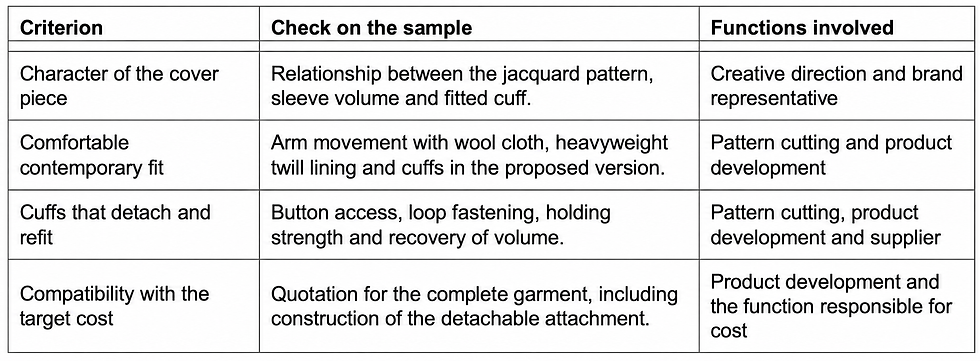
On the coat, the check returns to the refitted cuff: does the sleeve remain free of tension and regain the intended proportion? That observable result allows the person approving it to confirm the solution or ask for a change.
In your work, when does a technical change alter a proportion enough to require renewed creative approval? Who brings that change to the brand’s attention before the new solution is treated as final?
Romina Tosi
Disclaimer
The views expressed in this article reflect my personal analysis of the information available at the time of publication. The sources consulted are publicly available and may include official documents, trade union communications, press reports and other materials accessible to the public. Artificial intelligence tools were used to support the identification, consultation and preliminary verification of sources, as well as to locate and check the links included in the article. Before publication, I reviewed the relevant sources and verified that the links corresponded to the materials cited. AI assistance does not replace my editorial judgment or my responsibility for the final text. Links were checked at the time of publication and may subsequently be changed, moved or removed by their respective publishers. I do not disclose confidential information or information obtained through privileged professional access. Facts, statements, allegations and opinions are presented according to their nature. References to individuals, companies or specific cases are included to examine matters of broader relevance to the industry. They are not intended to attribute unlawful conduct beyond what is expressly documented in the cited sources. Assessments concerning industrial strategies, financial decisions and production models represent personal opinions, not findings of fact or definitive judgments.
If you identify an error or inaccuracy, please let me know. I will verify the information and correct it where necessary.
The purpose of this article is to contribute to informed discussion, not to harm any individual, company or organisation.



Comments