New York: Does Desire Still Need Spectacle?

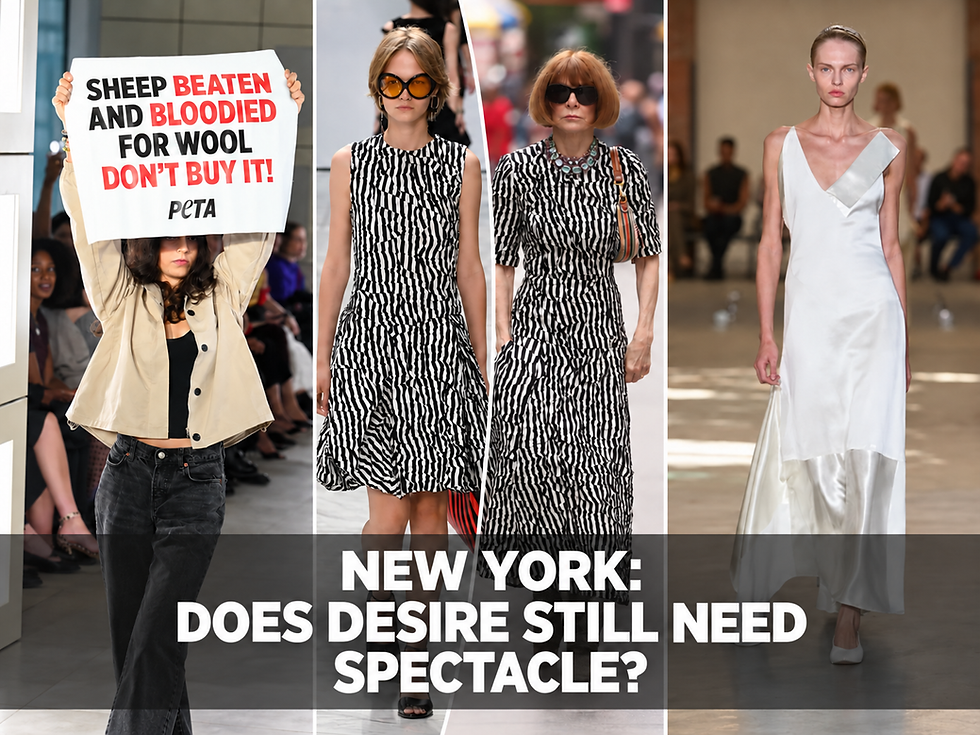
Photo credits, from left: COS Spring/Summer 2027, Getty Images via InStyle; Michael Kors Spring/Summer 2027 and Anna Wintour, Shutterstock and Romain Maurice/Getty Images, collage via the New York Post; Calvin Klein Collection Spring/Summer 2027, Filippo Fior/Gorunway.com via Vogue Runway.
On Sunday, September 13, when this piece was completed, New York Fashion Week had moved just past the halfway point in its calendar. The evening shows and the final two days, September 14 and 15, were still to come, but different ways of creating desire were already beginning to emerge.
New York still believes in staging. Culturally significant locations, casting, music, front rows capable of making news before the show has even begun. The point is not how spectacular a presentation may be. What matters is what remains once the staging is removed.
Some brands use the setting to make the product easier to read. Others generate images that are far stronger than the clothes they are meant to support. Sometimes spectacle arrives uninvited and takes over completely.
That happened on Sunday, September 13, during the COS Spring/Summer 2027 show. Five PETA activists stood up at different moments, held signs protesting the use of wool and interrupted the runway. There was also a physical confrontation between one protester and a member of the audience. The first reports focused mainly on this. The clothes receded into the background.
It was not part of the staging planned by the brand. It would therefore be unfair to judge the collection on the basis of the interruption. The episode does show, however, how quickly attention can shift: people arrive to see a collection and leave remembering a placard, a protest and an altercation.
This analysis covers the shows available up to the afternoon of September 13 in New York. It does not include Sunday evening’s events or the shows scheduled for September 14 and 15, from Ulla Johnson and Diotima to Carolina Herrera, Collina Strada and Thom Browne. The full calendar is available on Vogue Italia. This is a reading of a week still in progress, not a final assessment.
When the Setting Continues Through the Product
Michael Kors presented the collection in the sculpture garden at the Museum of Modern Art. The references to Carmen Herrera, Alexander Calder and Ellsworth Kelly did not remain confined to the set or the press notes. They carried through into graphic stripes, cuts, blocks of colour, jewellery and proportions.
The sequence included striped summer dresses, suits, one-shoulder pieces, embroidery and bags that belonged to the same conversation without looking like supporting actors at the MoMA. The location added authority and produced recognisable photographs, but the clothes did not lose their voice when isolated. A well-balanced stripe continues to direct the eye against a white background. A Calder-inspired earring still makes sense on a product page.
There was also an almost suspiciously perfect piece of communication. Anna Wintour arrived at the show wearing a striped outfit from the collection. Twenty minutes later, a version of the same motif appeared on the runway. The product anticipated the spectacle by dressing the person everyone would have photographed anyway. New York still knows how to organise a coincidence.
When Removing Requires More Confidence Than Adding
Calvin Klein Collection chose the Terminal Building and four sculptures by Walter De Maria. On the soundtrack, Solange spoke about minimalism as the search for what is necessary. A setting like this carries a risk: art can lend importance to clothes that possess less of it on their own.
Veronica Leoni responded with garments that did not ask the setting for protection: cotton blazers, pale high-waisted jeans, grey plaid trench coats, slim skirts, silk jersey T-shirts and slip dresses. In the bias-cut white dress, the matte and glossy sides of the silk created the detail without adding decoration. The full sequence allows the viewer to examine the front, side and details, rather than only the frame selected for the press.
Reduction works when it leaves construction and proportion visible. If it merely removes elements, what remains is poverty. In this collection, desire is concentrated in the silhouette and in the possibility of recognising a wardrobe, not in the special effect.
A Garment Should Not Need a Good Side
During a fitting, the first sign comes when you look at a garment and feel no need to alter it. There is no need to search for an angle that will save it. The proportions are right; the fabric and the design speak to each other and create something that feels alive.
To understand whether a show has strengthened the product, mentally remove the music, location, casting and front row. Is the silhouette still recognisable? Does the fabric support the volume even in a straight-on photograph? Does the detail retain its meaning up close? Does the bag, jacket or dress remain desirable outside the sequence?
A show also exists to generate press, culture and a sense of belonging. It can offer a community an image in which to recognise itself, open a conversation and alter the perception of a brand. It would be naive to measure it solely against the future sale of a coat, especially when that data does not yet exist.
COS reminds us that attention does not always obey the direction. Michael Kors shows how a setting can enter the form without replacing it. Calvin Klein chooses an important space and then leaves the clothes with the less conspicuous task: holding the gaze once everything else has been removed.
The following shows may change the picture. Up to the afternoon of September 13, New York seems to suggest that desire is perfectly willing to accept spectacle. It simply expects to find the product again when the lights come back on.
Romina Tosi
Disclaimer
The views expressed in this article reflect my personal analysis of the information available at the time of publication. The sources consulted are publicly available and may include official documents, trade union communications, press reports and other materials accessible to the public. Artificial intelligence tools were used to support the identification, consultation and preliminary verification of sources, as well as to locate and check the links included in the article. Before publication, I reviewed the relevant sources and verified that the links corresponded to the materials cited. AI assistance does not replace my editorial judgment or my responsibility for the final text. Links were checked at the time of publication and may subsequently be changed, moved or removed by their respective publishers. I do not disclose confidential information or information obtained through privileged professional access. Facts, statements, allegations and opinions are presented according to their nature. References to individuals, companies or specific cases are included to examine matters of broader relevance to the industry. They are not intended to attribute unlawful conduct beyond what is expressly documented in the cited sources. Assessments concerning industrial strategies, financial decisions and production models represent personal opinions, not findings of fact or definitive judgments.
If you identify an error or inaccuracy, please let me know. I will verify the information and correct it where necessary.
The purpose of this article is to contribute to informed discussion, not to harm any individual, company or organisation.


Comments