The product page is the customer’s first fitting without the garment


John Galliano’s Re{form} for Zara: what needs to happen between wanting a collection and choosing a garment.
“Let’s go and see the product. Then give it time.”

Matteo Pegoraro writes these words during our private discussion about Re{form}, John Galliano’s collection for Zara. The conversation we shared in “Fashion moves fast. But what is it building?”, the article we wrote together, continued privately after the collection launched. Before, we were questioning the system that might make it possible. Now we have photographs, descriptions and prices to look at.
Matteo offers a reading I share: Zara could accommodate different levels of value within the same structure. Re{form} would allow us to observe its ability to bring in the expertise and manufacturing skills suited to a project that differs from its usual offer. How well they can work together, and how consistently, remains to be seen.
I come back to the practical conditions: how much room was given to research, which techniques were retained during development, how that expertise shows in the finished garment. Starting with an existing product can involve complex work to transform it and make it reproducible. Zara’s scale tells us what it could support; to understand what it has achieved, we need to look at the result.
Then there is the price. I had sent photographs of the Mary Janes to a friend who regularly buys luxury shoes. She liked them, but thought they were too expensive for Zara. A friend of Matteo’s, on the other hand, saw Galliano straight away. Two individual responses, insufficient to describe an audience, but useful for understanding how much expectations can change when looking at the same product.
Matteo finds the question “Zara or Galliano?” reductive. He is interested in the value created when the two systems meet. I am also interested in what customers have been taught to expect from the brand, and what might persuade them to come back. The name shapes the first impression; after the purchase come the fit of the shoe, the fabric against the skin, the freedom to move.
The Mary Janes made us pause over the details of the sole and its junction with the heel. With the leather pieces, we wanted to understand the feel, the construction and the fit. About the tulle dress, I wrote to Matteo that I wanted to see it “outside, inside and sideways”: to understand how the seams are finished and what supports that shape as it moves on the body.
We were still looking at images. The desire was already there; judging the product meant having it in our hands.
I am drawing on some of those reflections to develop my own reading of the stage before the fitting. Anyone buying online has to choose from what the brand shows them. The product page is the customer’s first fitting without the garment. They read images, text and measurements to imagine it on their own body. Before checking whether the product delivers on its promise, they need to understand what that promise is.
Take one specific case: €599 for the black tulle dress, style 8533/882/800. Zara’s product page describes it as semi-sheer; from the photograph, I would say completely sheer. The first images show the front and back. The garment’s design language is recognisable. Deciding whether to wear it, though, calls for another kind of reading.
How closely does it fit? Where does the shortest part of the hem end? How much coverage does it provide, and how much comes from what the model is wearing underneath? Online, these questions arise before the fitting, while the customer still has only images and words.
The page examined, on Zara’s Spanish site in English on 4 October 2026, lets us observe this stage without attributing intentions to the brand. A collection with such a recognisable design language makes the work a product page needs to do particularly clear.
How Zara presents this dress
The gallery contains six photographs: two on a model, two of the dress on its own and two detail shots. The views without a model help us follow the lines of its construction. The details bring us closer to the fabric and the hem.
The text mentions semi-sheer fabric, a draped neckline, cape sleeves with ruffles, defined seams and an asymmetric hem with lace. These are relevant details: they name features we can look for in the photographs.
There are also garment measurements, composition and care instructions. So the information exists. The limitation emerges when I try to use it to make a choice: some of the details describe the dress, but do not explain enough about its relationship with the body.
In the photographs of the dress being worn, the model holds up part of the fabric. The gesture shows its lightness and opens out the silhouette. To understand how it falls without that intervention, though, we need another image. The dress photographed on its own helps us read its shape; it does not show how that shape settles on the shoulders, over the hips or during a step.
The social media image should make us want that world. The product page should let customers understand whether that garment could fit into their lives. It can retain the same photographic language, as long as it adds answers.
Baymard’s research on photographs of clothing on models recommends at least one image that clearly shows the fit, without styling interventions that obscure it. This is a particularly useful criterion when a garment’s construction is unusual.
What is missing and should be there
For this dress, I consider a few additions essential. These observations concern the product page and its information panels examined yesterday.
The model as a reference. On the page examined, I cannot find the model’s height or the size she is wearing, nor body measurements to relate to the photograph. These details are essential for interpreting proportions and fit. Seeing a size S on a body whose height, bust, waist and hips I know allows me to make an informed comparison. A letter alone does not explain how much room there is between the fabric and the body.
Baymard’s research on sizing information shows how customers use model details alongside the size guide. I would therefore place them next to the size selector, without making people search elsewhere.
An explanation of coverage. The composition distinguishes between the outer fabric and the lining, but does not explain which areas are lined or how this affects transparency. The text does not state whether the underwear visible in the images is included in the product being sold. Buyers need to know what they will receive and which additional layers they may need to source themselves.
This calls for an explicit note and a view that clearly shows the different layers. Describing a garment as “semi-sheer” is useful; choosing it also means understanding where, and how much. Transparency is an aesthetic choice the customer should be able to make knowingly.
The lengths that explain the asymmetry. The table lists waist, hips and total length. For size S, the total length is 193.2 centimetres. One overall measurement does not tell us where the shortest part ends or how much of the longest part touches the floor.
Both lengths should be given, with their measurement points, and shown on the body in a pose that lets the hem fall freely. The practical question is simple: can I walk in it as shown, or will I have to hold part of the fabric in my hand?
Zara explains that the measurements are taken with the garment laid flat. This is a useful clarification: the 42.2 centimetres at the waist in size S measure the width of the product, not the circumference of a body. The figure should be compared with a similar garment measured in the same way. To choose a size, however, we still need to understand how it fits and how much the material can move with the body.
A description of the fit and how the fabric behaves. I cannot find any indication in the text of stretch, or of the areas intended to fit closely or hang loosely. Composition alone is not enough to work this out. We need information checked against the sample: where it sits close to the body, how freely it allows movement, how the draping falls.
The handle, meaning how the fabric feels to the touch, also deserves a concrete description. Saying whether a fabric is soft or firm, dry or slippery requires having touched it. The text should report what the product team has checked, without adding adjectives to make the page sound more luxurious.
The inside and how to put it on. The gallery’s detail shots show the outside; there is no dedicated view of the inside to help us understand seams, layers and what holds the draping in place. The description does not explain how to put the garment on or what openings or fastenings it has. With such a complex construction, this is practical information as well as a way to show the work that went into making it.
In my conversation with Matteo, that “outside, inside and sideways” came from precisely this interest. A close-up photograph of the surface can show the line of a seam. To understand how it is constructed, we also need to see the other side. A product page cannot certify quality, but it can provide information to help assess it.
The natural fall and movement. I cannot find a video of the dress being worn in the gallery examined. I would add one, together with a side view and a photograph with the fabric left to fall freely rather than held up. A few steps and a turn are enough, with the hem kept in frame.
Customers can then observe what happens to the draping, how the layers shift and how much space the dress takes up. A campaign film can tell a character’s story; this footage needs to let us follow the product.

What the teams need to check together
The information to be added requires shared work. This is a practical outline for the garment examined, to be adapted to the characteristics of each product.
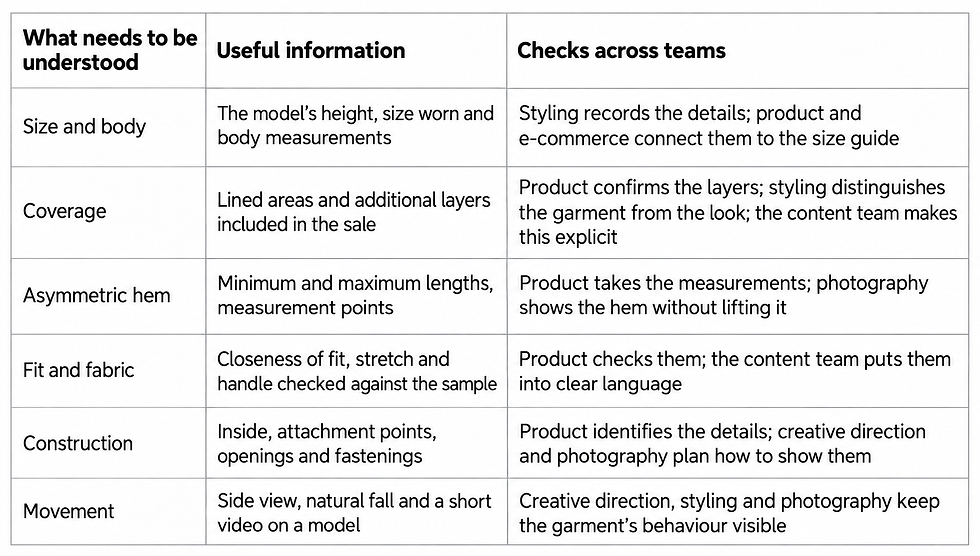
This work begins before the shoot. If the shape depends on an unusual construction, the photography brief needs to plan how to show it. If the sample is adjusted on set, the intervention should be recorded so the team can assess how closely the image represents the product being sold. Any subsequent change to length, lining or volume then requires the content to be checked again.
The e-commerce team organises this information around the customer’s questions. Creative direction keeps the collection’s design language clear; the product team confirms that what the page describes corresponds to the finished garment.
What we are buying
Towards the end of our conversation, Matteo and I also agreed on the need to understand purchases in terms of the different reasons behind them. Some people buy Galliano, recognising his language and wanting to own a piece of his work. Some assess the offer as a Zara product, with the expectations they associate with the brand. Others buy for a personal archive or collection, to preserve and study a dress or a shoe, even with no intention of wearing it.
Our interest in the Mary Janes had led Matteo and me to consider precisely that last possibility. Holding them, turning them over, examining how a construction detail had been resolved could be a reason to buy. These motivations can coexist in the same person. They change how the price is assessed and what someone looks for in the product.
One condition remains common to all: being able to understand what we are buying. Anyone who wants to wear the dress needs to assess its fit and use. Anyone who wants to preserve and study it also looks for information about its construction and the techniques used. The designer’s name draws interest, but the product page needs to make clear the specific piece that will arrive at home.
For anyone who cannot reach the Madrid and London flagships or the temporary installation in Paris, buying online is the necessary step to experience the product firsthand. The distribution of this first release makes this point particularly concrete.
For these customers, the physical assessment comes after they have paid. Photographs, measurements and text therefore need to cover everything that can be known before ordering. Shape, coverage, fit, construction and what is included. The fabric against the skin will remain a physical experience. Knowing which garment will arrive should already be possible on the page. And the notice “This item has special conditions for returns” needs to be read carefully: anyone buying in order to examine the garment firsthand must also know that they will need to keep the special packaging in case they return it.
Romina Tosi with complicity of Matteo Pegoraro
Disclaimer
The views expressed in this article reflect my personal analysis of the information available at the time of publication. The sources consulted are publicly available and may include official documents, trade union communications, press reports and other materials accessible to the public. Artificial intelligence tools were used to support the identification, consultation and preliminary verification of sources, as well as to locate and check the links included in the article. Before publication, I reviewed the relevant sources and verified that the links corresponded to the materials cited. AI assistance does not replace my editorial judgment or my responsibility for the final text. Links were checked at the time of publication and may subsequently be changed, moved or removed by their respective publishers. I do not disclose confidential information or information obtained through privileged professional access. Facts, statements, allegations and opinions are presented according to their nature. References to individuals, companies or specific cases are included to examine matters of broader relevance to the industry. They are not intended to attribute unlawful conduct beyond what is expressly documented in the cited sources. Assessments concerning industrial strategies, financial decisions and production models represent personal opinions, not findings of fact or definitive judgments.
If you identify an error or inaccuracy, please let me know. I will verify the information and correct it where necessary.
The purpose of this article is to contribute to informed discussion, not to harm any individual, company or organisation.


Comments