A Fashion Show Is Not a Collection

Updated: 4 days ago

The lights go down after a few minutes. What remains are the clothes rails, the sales appointments and the least photogenic question of all: what will the customer actually buy?
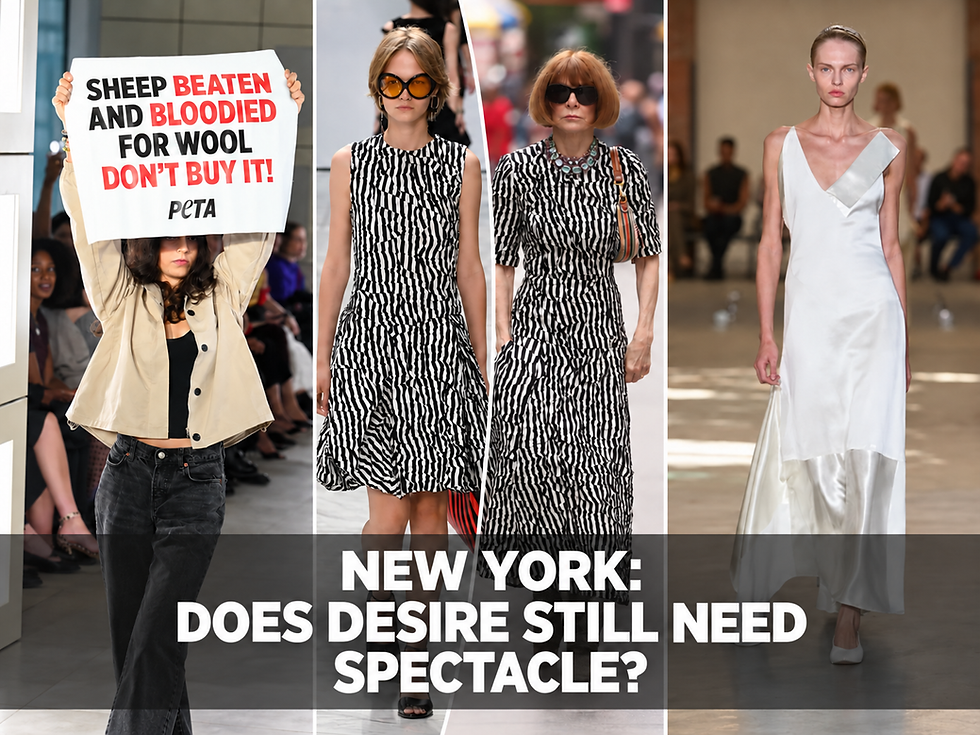
On 10 September, New York Fashion Week opens for the Spring/Summer 2027 season. The CFDA’s preliminary calendar includes 70 runway shows and presentations, with further collections shown by appointment or released digitally. That distinction alone should make us cautious: fashion is presented in many different ways, yet social media tends to reduce it to the same ten looks. Often the same three.
A powerful image can tell us a great deal. It can establish a silhouette, impose a proportion, make a colour or a styling gesture recognisable. On its own, it cannot tell us whether the collection has depth, whether its categories speak to one another, whether the price architecture is credible or whether customers will find a point of entry without feeling they have been directed to the side door.
A fashion show creates attention. A collection must also create choice.
Confusing the two produces very fast reviews and rather lazy judgements: the most spectacular look becomes the collection, the most shared photograph becomes the strategy, the most extreme garment becomes proof of commercial potential. Instagram, meanwhile, does not check the pricing ladder. It has other commitments.
Four functions, not four levels of importance
Products do not all perform the same task within an assortment. The terminology varies from one company to another, but the functions remain recognisable.
The statement look concentrates the message. It may exaggerate volume, fabric, styling or construction to establish the creative territory immediately. It is not necessarily expected to generate volume. Its job is to make the collection visible and prevent it from becoming interchangeable.
The image product brings that message closer to real life. It retains enough character to carry a campaign, window display, editorial image and desire, while offering a fit and legibility that depend less on the direction of the show.
The carryover product gives the language duration. It may be a garment, accessory, construction or product family that customers can recognise and find again, with relevant variations, beyond one season. Continuity is not automatic repetition. The product still needs a reason to exist.
The entry-price product offers access to the brand at a more approachable price than the rest of the range. It should not look like the cheaper relative who received a last-minute invitation. It still needs enough material quality, detail, function or brand code to support the promise made by the label.
One product can perform more than one function. A bag can be both a statement and a carryover product; knitwear can become an image product; a small accessory can introduce a new customer without lowering the brand’s perceived value. The quality of a collection also lies in the relationship between these roles, not in the number of runway exits.
The most photographed look is often the exception
Social media rewards contrast, immediacy and surprise. An assortment needs repetition, variation, balance between categories and a certain amount of discipline. The two follow different rules.
If one look contains the only memorable print, the only new accessory and the only silhouette capable of stopping the eye, it has performed its image function very well. It may also reveal that everything else is there to accompany it. To understand which interpretation is correct, we need to leave the single photograph behind and examine the complete sequence.
The first check concerns language: which elements return, and how do they change? If a shape appears only once, it may be a gesture. If it moves through dresses, knitwear, outerwear or accessories without becoming mechanical, it starts to form a grammar.
The second concerns categories. A collection may be highly convincing in dresses or outerwear and remain fragile if it offers no alternatives, layering pieces, accessories or products for different occasions. A runway can conceal the gap with impeccable styling. A showroom is usually less cooperative.
Then come the details: declared materials, construction, fastenings, finishes, visual weight and the way a garment behaves on the body. Images help, but they have limits. They cannot establish actual quality, comfort, cost or margin. When those facts are not public, the judgement has to stop.
Finally, there is the scale of the offer: variations, colours, categories, price levels and continuity with what the brand already sells. Collection merchandising begins before the show, working on the category mix, approximate SKU counts, pricing and production considerations. Retail merchandising enters later, when the collection is examined in the showroom and translated for stores, markets and customers. The runway is a central stage, not the entire process.
Distance between show and product is not a flaw
Expecting every runway look to appear ready for e-commerce would remove one of the show’s functions: amplification. Assessing how “commercial” a show looks is not particularly useful. The word often arrives with all the elegance of a tax inspection. What matters is what happens when the direction is removed.
There are at least three possible outcomes.
In the first, the message is translated: an extreme proportion becomes a wearable construction; a rare material finds a coherent alternative; one detail moves across several categories. The intensity changes, but the idea remains recognisable.
In the second, the message is replaced: casting, music, location and styling generate almost all the meaning. Once removed from the scene, the product loses its voice. That is not an early conviction, simply something worth observing.
In the third, the distance is eliminated: the runway presents an assortment that is already orderly, legible and complete. It may be a precise decision. It may also leave desire sitting in the front row, waiting for something that never arrives.
I will therefore use five questions when reading the shows opening in New York: what language is being declared; how many categories can carry it; what is repeated through genuine variation; what product and price range is visible; what could survive beyond the photographs of fashion week.
The runway will not provide every answer. Some will appear in the complete image sequence, others in official details, press notes, lookbooks and commercial presentations. Orders, sell-through and buyer reactions will remain outside the discussion until public data exists.
The rest will require patience. A word rarely seen during fashion week.
References: CFDA, Preliminary Official September 2026 NYFW Schedule; Vogue Business, “How to Merchandise a New Creative Director’s Collection”.
Romina Tosi
Disclaimer
The views expressed in this article reflect my personal analysis of the information available at the time of publication. The sources consulted are publicly available and may include official documents, trade union communications, press reports and other materials accessible to the public. Artificial intelligence tools were used to support the identification, consultation and preliminary verification of sources, as well as to locate and check the links included in the article. Before publication, I reviewed the relevant sources and verified that the links corresponded to the materials cited. AI assistance does not replace my editorial judgment or my responsibility for the final text. Links were checked at the time of publication and may subsequently be changed, moved or removed by their respective publishers. I do not disclose confidential information or information obtained through privileged professional access. Facts, statements, allegations and opinions are presented according to their nature. References to individuals, companies or specific cases are included to examine matters of broader relevance to the industry. They are not intended to attribute unlawful conduct beyond what is expressly documented in the cited sources. Assessments concerning industrial strategies, financial decisions and production models represent personal opinions, not findings of fact or definitive judgments.
If you identify an error or inaccuracy, please let me know. I will verify the information and correct it where necessary.
The purpose of this article is to contribute to informed discussion, not to harm any individual, company or organisation.


Comments